Blog

  • We’re Back in the Bahamas … Cruising Season 2022!

    We’re Back in the Bahamas … Cruising Season 2022!

    It’s been such a long time ago since I posted to this blog, I’m having a hard time figuring out where to start. Every time I sit down to write, I’m soon enveloped with panic over all that I’ve missed since our last post. Once the panic sets in, I cease being a writer and instead decide it’s time to take a nap. Jane finally put her foot down. If I want lunch, I must write!

    I just checked. We last posted on March 30, 2021! That was over a year ago! We were leaving our anchorage at Key Largo and heading over to the Bahamas for the first time.

    Now, one could come to several possible conclusions to explain our silence after that post. First, you could conclude that somewhere after our arrival in Bimini last year, the boat sank. Or, you could conclude that we had such a horrible time in the Bahamas that we didn’t want to talk about it. Or, you could conclude that we had such a wonderful time that we found it impossible to put into words our magical, life transforming experience.

    The first two possibilities would be wrong. The third is right on the money!

    In fact, we spent over 100 days of the year 2021 – from the third week of March through the end of June – in the northern Bahamas exploring Bimini, the Berry Islands and the Abaco Islands. We traveled close to 600 miles while exploring those beautiful waters. The whole experience was breathtaking! We’d love to catch you all up on that trip, but it’ll have to wait for another time. What we really need to do is catch you up on our current cruising season in the Bahamas … the cruise of 2022!

    After returning to the States the end of last June, we spent the summer of 2021 and hurricane season in Florida doing repairs and upgrades to Dejarlo, while spending time with our wonderful friends in the Vero Beach/Fort Pierce area.

    On February 4th of this year, we departed our marina in Sebastian, Florida, heading south along the coast past Miami to Key Largo in the northern Keys. From there we planned to cross over to Bimini in the western Bahamas once again, a trip of approximately eighty miles. On February 27th, at 4:00 am, we left our anchorage off Key Largo, headed offshore several miles into the Gulf Stream and pointed the bow of Dejarlo towards Bimini. We arrived at Bimini Bluewater Marina and tied Dejarlo into our slip about twelve hours later.

    Following all the Bahamian Customs and Immigration formalities, we quickly settled into the Bahamian culture as we waited several days for the passing of inclement weather allowing us to proceed on the next leg of our trip east into the Bahamas – a long, 80-mile crossing of the Bahama Banks to the southern tip of the Berry Islands. From there, it was another thirty miles across the “Tongue of the Ocean” to the cruise ship capital of the Bahamas … Nassau.

    After a few days in the bustling city of Nassau, where we enjoyed the big city luxuries of large grocery stores, Domino’s Pizza and Dairy Queen ice cream, we headed thirty-five miles southeast to Highborne Cay, located towards the northern tip of the Exuma island chain. We would spend the next two months exploring as much of this majestic 365 island chain as possible – from Highborne Cay in the north, to George Town in the south.

    Our path down to George Town

    Many cruisers don’t make it as far south in the Exumas as George Town. It’s pretty far south and requires leaving the usually docile Bahama Banks to head out into the sometimes angry, deep-water Exuma Sound to get to George Town. We’re glad we made the effort, as this is a cruising mecca for many and a yearly destination for hundreds of boats. When we arrived, there were 350 boats anchored around the George Town harbor. Many cruisers from many foreign lands come here for many months at a time. The previous stewards of Dejarlo (Pam and Ollie) came here every year for several months each year for several years. Dejarlo was happy to be back in George Town waters. You could almost hear her giggling with excitement! We even got some calls on the VHF radio from long-time “George Towners” who remembered Pam and Ollie on Dejarlo from years back, excited to see “the famous Dejarlo” back in the harbor.

    Dejarlo anchored off Monument Hill in George Town
    The anchorages of George Town in the distance with 350 boats
    With friends in George Town

    This is a wonderful cruising community. We understand now why this is a yearly destination for so many boats. In addition to the beautiful waters and comradery of fellow cruisers, you can find just about all the supplies and provisions that you would find back in the States. And, if you find yourself with some type of boat problem that you’re struggling to solve, just get on the VHF radio and ask for some assistance. There will be at least five dinghies tied up to your stern within fifteen minutes with a helping hand!

    We were going to stay here for a week before moving on. We stayed three weeks!

    Drinks at the Chat ‘n Chill beach bar in George Town

    From George Town, we moved back north to explore those areas of the Exumas that we missed in our rush to get south to George Town. In particular, we wanted to spend time in the breathtaking 112,000 acre, 22-mile long Exuma Cays Land and Sea Park. What a place! In total, we spent about two weeks in the Park, dinghying to remote corners of the islands, swimming and snorkeling in crystal clear water. Sorry, no fishing in the Park. These fish are protected. And they know it. Turtles, sharks, and other wildlife come right up to the boat to say hello. It was truly a sight to behold, and we can’t wait to come back again next year.

    Anchored in beautiful Warderick Wells, part of Exuma Cays Land & Sea Park

    We ended our stay in the Exumas at Warderick Wells, probably one of the most spectacular anchorages in the Exumas, and certainly during our time on Dejarlo. I’ll have more to say about Warderick Wells in an upcoming post.

    After a pleasant eight-hour passage east from Warderick Wells, we arrived at Rock Sound on Eleuthera Island, where we are currently anchored for a few days.

    From here, we’ll head north to Hatchet Bay while continuing our exploration of Eleuthera, then on to Spanish Wells at the northern tip of Eleuthera where we’ll spend about a week getting to know that popular cruising destination.

    Time for a hair cut …
    … and not a bad view overlooking Dejarlo at anchor off Black Point

    After that, it’s a fifty-mile crossing from Eleuthera to a familiar anchorage at Little Harbour in the Abacos Islands. We’ll then spend the next month re-visiting familiar anchorages from last season and exploring new anchorages that we missed.

    Swimming with nurse sharks at Compass Cay Marina

    We should be returning to the States around the first of July after a total of over 1,000 miles this season. After settling into life back in the States, we’ll make some decisions about where we’ll be spending the summer hurricane season, and our plans for the cruising season of 2023.

    We’ll keep you up to speed with our plans and promise to do a better job with descriptions, pictures, and videos of the wonderful stops we’ve made along this journey so far.

    Hope all is well with everyone. We’ll visit again soon!

  • Postmark: Bahamas!

    Postmark: Bahamas!

    The alarm sounded at 2:30 am. Ordinarily, the sound of an alarm at this hour of the morning would have startled me awake. However, I hadn’t slept a wink since my head hit the pillow 5-1/2 hours earlier. Jane and I were about to undertake a 75-mile offshore passage from Key Largo, Florida to the island of North Bimini in the Bahamas. Ordinarily, a 75-mile passage would be no big deal for us. We had done several 75-mile offshore passages while cruising up and down the U.S. east coast. This time, however, we had to deal with the dreaded Gulf Stream, a strong north-flowing current originating in the Gulf of Mexico and following the eastern coastline of the U.S. The stream averages 50 – 60 miles wide, with a current averaging about 2 knots.

    I’d been agonizing about this Gulf Stream crossing for months. I’d read articles warning of its dangers. I’d gone to seminars presented by experts on Gulf Stream navigation. I’d watched YouTube videos and talked to dozens of fellow cruisers from around the marinas who had done it dozens of times. I’d spent hours studying my charts while carefully calculating a course and heading to compensate for the anticipated current speed. I’d fully prepared. I was nervous as hell!

    (Note to reader: At least on this passage from Key Largo, it turned out to be no big deal. Just point the boat towards Bimini and make some minor heading adjustments along the way to stay on a straight-line course to Bimini. Piece of cake; easy sneezy.)

    A good weather window is without question the most important aspect of a successful Gulf Stream crossing. Winds that come out of the north will conflict with the north-flowing Gulf Stream and can produce waves the size of railroad box cars. So, it’s important to sit patiently and wait for the right weather conditions. Sometimes this wait can last several weeks. We’d waited about ten days in Key Largo for the optimal conditions. We’d contracted the services of a professional meteorologist (Chris Parker) to tell us when to go. He was telling us to go … now! The winds were light out of the southeast and the waves in the Atlantic were forecasted at 2-4 feet, 8 seconds apart. These were good conditions for Dejarlo and her crew. We had a one-day window. Let’s go!

    Our Predictwind weather app.
    Careful monitoring of offshore wind and wave conditions is essential to a smooth Gulf Stream crossing.

    We had purchased Dejarlo three years ago, always with the intention of taking her to the Bahamas, and points beyond. Since our first trip heading north to the Chesapeake from Florida in early May, 2018, we’d traveled more than 4,000 miles along the coast – from Fort Pierce, Florida to Solomons, Maryland to Key Largo, Florida, back to Solomons, Maryland, and finally back to Key Largo. For those that have followed this blog, you know that our first trip to Key Largo in 2020 was for the purpose of crossing over to the Bahamas. As (bad) luck would have it, just before our departure, the Bahamas closed its borders due to the Covid pandemic. We spent almost three months anchored off Key Largo before making the long trip back up to Maryland, our home port during hurricane season.

    Now we’re back at Key Largo, ready to try again. This time it looks like we’ll make it. The required Covid tests necessary to enter the Bahamas are completed, we’ve provisioned the boat to overflowing, and all the necessary paperwork is in order. The only requirement now is to start the engine and make our way out of our anchorage, cross over Molasses Reef five miles to the east of us, and head out into the Atlantic Ocean.

    We pulled up anchor at 4:00 am, making our way east while carefully monitoring our Navionics navigation app displaying our GPS position. It was pitch dark! We were all alone except for a couple of early morning fishing boats heading out past the reef. An hour later we were in the open Atlantic. I pointed Dejarlo towards Bimini and settled in for, what turned out to be, a twelve-hour passage.

    The sun slowly begins to peek over the horizon as we make our way northeast towards Bimini.

    There was no wind, so sailing was out of the question. We motored the entire trip. The downside to having no wind is not being able to sail. On the flip side, no wind ordinarily means very small waves. And that is exactly what we experienced, very small waves. That is with the exception of the fifteen-foot high “rollers”, spaced about twenty seconds apart, that turned out to be rather fun riding up and down, kind of like a roller coaster.

    Our AIS system showed marine traffic in the area (we’re red, they’re green), but nothing on a collision course with us.

    As soon as we were in the Gulf Stream, I noted a couple of degrees increase in sea temperature along with a very notable change in water color – to a color somewhere between turquoise and emerald green, with some occasional cobalt blue mixed in. We saw very little marine traffic except for a few cargo ships that never got more than a mile or so from us. However, our fancy AIS system (similar to an aircraft transponder system) indicated several vessels, both commercial and pleasure craft, within ten miles of us, some clearly also headed to Bimini.

    About five miles out from Bimini, I called out “land ho”, as I could clearly see the entrance to Alice Town on North Bimini.

    Time to hoist the quarantine flag as we enter Bahamian waters.

    An hour later we were tied up at the Bimini Big Game Club Marina, handling Customs and Immigration forms, and preparing for a long night of much needed sleep.

    After three years of boat refits, repairs, and 4,000 miles of coastal cruising, we were finally in the Bahamas!

    A couple of spotted eagle rays, each with 5′ wingspans, play under our boat.
    Walking the narrow streets of Alice Town on North Bimini

    This place is filled with history. As I write this blog post from the comfort of Dejarlo’s cabin, I’m reminded that less than twenty-five yards from me is the, now in ruins, cabin where Ernest Hemingway stayed during his many visits to Bimini. He kept his famed fishing boat, Pilar, just a short distance from where Dejarlo now sits. From his many visits here came the inspiration for his books, Islands in the Stream and The Old Man and the Sea. If you use your imagination, you can still hear Hemingway’s boisterous laughter coming from across the road as he recalls the day’s fishing adventures with his Bahamian drinking buddies.

    Hemingway’s Cabin

    We’ll be here for about a week as we enjoy the local Bahamian culture and wait for a good weather window to continue our journey further east across the Bahama Banks to the Berry Islands, and waypoints beyond. We’ve got about three months before we must return to the States and settle in somewhere for hurricane season. We should be able to see lots of the Bahamas in three months.

    More on our Bimini experience later. Perhaps Hemingway’s ghost can inspire my next post.

    Enjoying the iconic conch salad with an equally iconic Kalik beer
    In spite of the beauty all around, there’s a constant reminder of past hurricanes.

    A word from Jane regarding the Commonwealth of the Bahamas …

    What do you think when you hear those words? Most think of sandy islands, fifty shades of blue water, warm breezes, swaying palms, pastel-colored homes and buildings, and friendly islanders.

    Yes. That’s it, all those words and, we suspect, many more to come.

    Some history of the Bahamas:

    We all know the story of Christopher Columbus (and his three famous ships) discovering America. Most historians now say no, that was already accomplished by others well before 1492. Columbus left Spain and reached a Bahamian island, probably San Salvador, and sailed around other nearby islands, Cuba, Hispaniola, and twenty years later America’s east coast. Then came invaders, sugar cane plantations, enslavement, traders, privateers, pirates, abolishment of slavery in 1834, and independence from Britain as a constitutional monarchy in 1973. History is everywhere on these islands.

    And us? We’re pretty awestruck and ready to go as soon as the next two high wind events have passed and the weather gods have cleared the way.

    Ah, three more months of awestruck, mon …

  • Heading South to the Warmth of Tropical Waters … Again!

    Heading South to the Warmth of Tropical Waters … Again!

    I just took a look, and it appears that our last blog post was way back on March 20th. That’s pretty close to nine months ago! We were in the Florida Keys, self-quarantining at anchor aboard Dejarlo for the COVID-19 pandemic, just beginning to pick up steam and wreak havoc across the world. Who would have thought at that time that we would still be dealing with this mess, and that close to 300,000 (so far) of our fellow Americans would have perished. It’s hard to comprehend.

    So, let’s bring everyone up to date with the current status of John, Jane and s/v Dejarlo.

    Following our almost three-month quarantine at anchor in the Florida Keys, we began the long journey up the east coast to the Chesapeake Bay and our home during hurricane season, Spring Cove Marina in Solomons, Maryland. From the Keys to Solomons is a trip of over 1,000 miles. With numerous stops to enjoy all the history and wonder of the east coast, it took us almost three months! However, the beauty of the trip and introductions to new friends made the trip well worth the struggle.

    We stayed in Solomons for ten weeks, tackling various boat projects and enjoying new friendships that will last a lifetime.

    Despite our love of Solomons, Maryland and Spring Cove Marina this is not a location where we can stay year-round. Around the first of October, the coming fall season is apparent. And right after that it quickly gets much colder than either of us can withstand.

    Our goal aboard Dejarlo has always been exploration of the warm tropical waters of the Bahamas and Caribbean. Due to the pandemic, we were cheated out of our first visit to the Bahamas last year. On October 20th, we departed Solomons, Maryland one more time to travel another 1,000 miles south along the east coast. Destination: the Bahamas and eastern Caribbean!

    Our first major destination would be Sebastian, Florida where we would complete more boat projects (they never end) and provision the boat for several months in the Bahamas. We arrived at Sebastian River Marina on December 4th, after a journey of 46 days, 973 nautical miles, 21 anchorages, 10 marinas (some to ride out storms, some to re-provision and do laundry, some just because we like the town and wanted to get off the boat to explore), and 142 gallons of diesel fuel.

    Click below to see a short video of some of the sights from our trip along the coast and down to Sebastian.

    [If you’d like to see our track along the east coast for the past couple of years, CLICK HERE. Be certain to click “View All Tracks” to see the entirety of our travels.]

    Whereas Spring Cove Marina in Solomons, Maryland has become our summer home, Sebastian River Marina, in Sebastian, Florida is the place we call home in the winter as we make our way further south for our crossing to the Bahamas. We’ll be here for about six weeks as we complete more upgrades to Dejarlo and visit with cherished friends living in the area.

    After that, we’ll depart Sebastian and head about 200 miles further down the Florida coast to Key Largo, where we’ll enjoy friendships made during our last stay there and make the final preparations for our 75-mile Gulf Stream crossing to Bimini in the Bahamas. At this point in the pandemic, rules for entry into the Bahamas include having taken a COVID-19 test within five days of arrival. We’ve determined that the best place for us to get the test and make the crossing, all within the 5-day window, is Key Largo.

    So, around mid-January, we’ll depart Sebastian and begin the journey down to our anchorage at Rodriguez Key, about a mile off Key Largo.

    We’ll talk to you again from there.

    Have a joyous holiday season, everyone.

    Stay safe!

  • Dejarlo is Back in the Water!

    Dejarlo is Back in the Water!

    She’s been out of the water for 328 days. She’s just completed a four-month refit, polishing and painting her bottom, updating and adding to her electronics, and just generally brightening her already happy smile. We’ve added all new electronics, including radar, an AIS transponder and forward scanning sonar. As our good friend Jim D. puts it, “Dejarlo is all tricked out!”.

    We’re putting the final touches on the refit and preparing to depart the Chesapeake Bay and head for southern destinations, including the Bahamas.

    So, what’s been going on with John and Jane since our return to Maryland following our 7,500-mile RV tour of the southwest U.S. this past winter?

    Most of our time has been spent working on Dejarlo in the hot boatyard – scraping, sanding, polishing and worrying over all the new things happening to her. Although we intended for only a six-week refit, the project took on a life of its own and the “little” refit turned into a “big” refit. New batteries, new solar panels, new motor mounts, new cutlass bearing, new radar, new instrumentation, new forward scanning sonar, new cushions, new bottom paint, new AIS transponder, new autopilot, … and on, and on and on.

    It’s been a long, hot and dirty process. But she’s back in the water and looking spiffy.

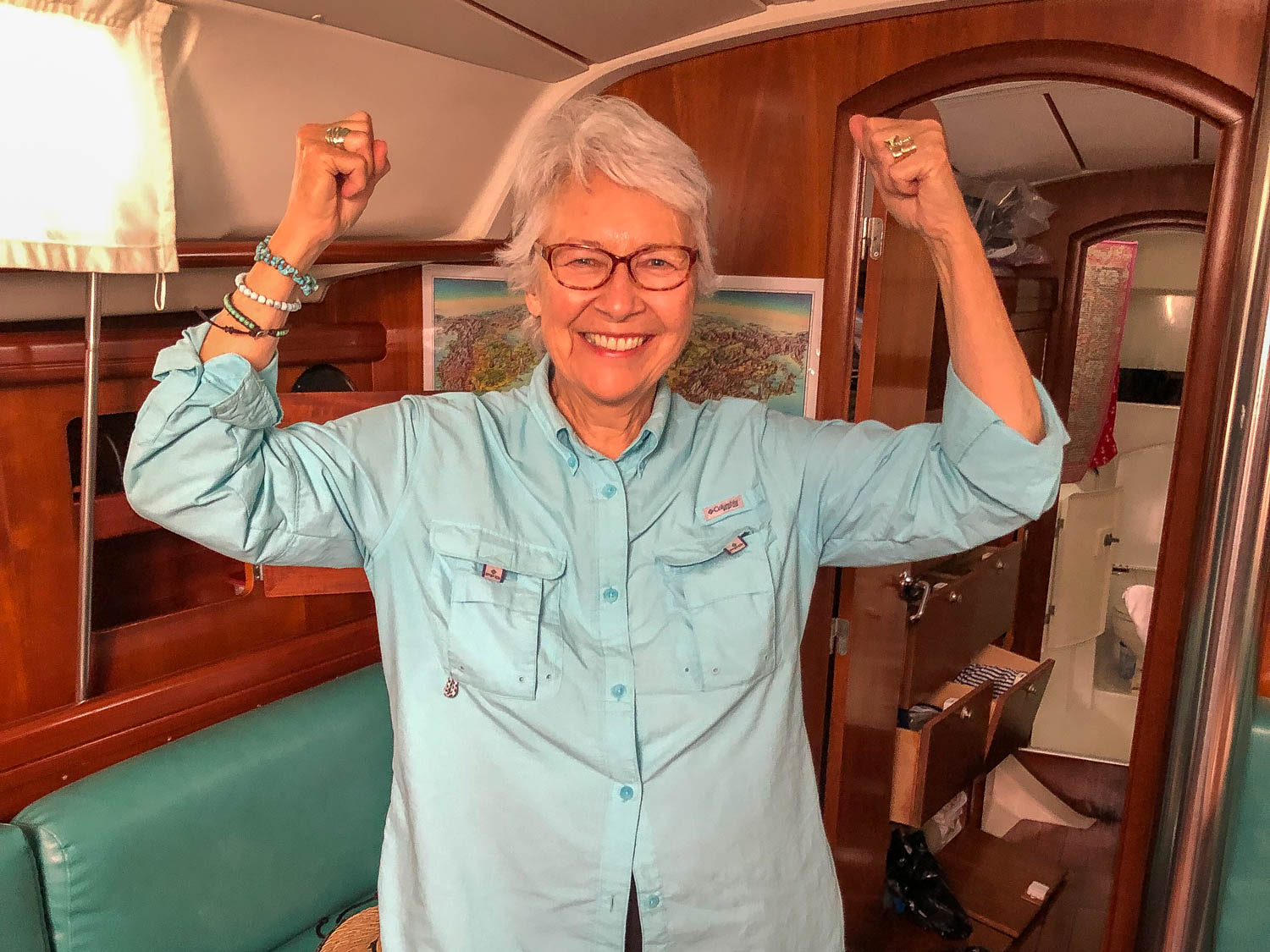
    Jane celebrates after discovering no mold following Dejarlo’s eight-month storage.
    A day in the life of repairing, sanding, cleaning and treating nearly eighty feet of teak toe rail.
    Installation of the new radar dome.
    John heads up the mast to repair the steaming and deck lights.

    But we haven’t totally been working!

    We took a little over a week off from boat work to join our friends Mike and Sue McCoy for a wonderful eight-day cruise of the northern Chesapeake Bay aboard PanaSea, a 43 foot trawler. What a wonderful experience. We did our best to explore as much of the Chesapeake’s eastern shore from St. Michaels to its northern tip. Of course, that’s pretty much impossible for such a large body of water, but we tried. Thanks Mike and Sue for inviting us along. It was truly an experience we’ll never forget.

    Captains Sue and Mike McCoy.
    Jane on the bow of PanaSea … on the phone, as usual.
    The good ship PanaSea.
    John and Mike enjoying a “cold one” after anchoring for the night in one of the numerous coves we discovered off the Chesapeake Bay.

    We also took some time off to celebrate Jane’s birthday and drive three hours to pay a visit to one of Jane’s favorite destinations – Thomas Jefferson’s Monticello. It’s not our first time to Monticello, nor our last. There have been some major renovations to the property since our last visit, including a new welcome center/museum and the opening of the upper floors of the home – a real treat!

    Jane is greeted by Thomas Jefferson at his home at Monticello.

    We’re currently preparing Dejarlo and ourselves to head south for Florida from Solomons, Maryland, sometime in late October or early November. For all practical purposes, hurricane season ends at about that time. We’ll keep a close watch on weather patterns in the Atlantic as we slowly make our way out of the Chesapeake Bay and down the coast.

    Last year our travels UP the east coast from Florida to the Chesapeake Bay were exclusively on the ICW, the protected “inside” passage extending 1,153 miles from Norfolk, Virginia to the Florida Keys. It’s a beautiful passage, but prone to uncharted shallow water and numerous bridges requiring an opening for our fifty-five foot mast.

    This year, heading DOWN to Florida, we’ll go offshore as much as possible once south of Beaufort, North Carolina. Our offshore hops will involve a distance of between seventy and a hundred miles while we stay about three to five miles offshore. Most of the hops will involve an overnight sail. Our longest transit will take us from St. Augustine, Florida to Port Canaveral, a distance of 133 miles requiring almost twenty-four hours. We’re really excited to take this next step in our cruising adventure, and we’re looking forward to documenting the experience on our blog and YouTube channel.

    It’ll take us about thirty to forty days to reach Fort Pierce, Florida, where we’ll spend a few weeks visiting with friends. We’ll then head down to a point just south of Miami (No Name Harbor) and wait for a good weather window for our twelve-hour trip over to Bimini in the Bahamas.

    We were originally planning to cross over from the Lake Worth Inlet heading to West End on Grand Bahama. We’d been looking forward to spending a couple of months exploring the beautiful Abaco Islands in the northern Bahamas. However, Hurricane Dorian ended that plan.

    After checking into the Bahamas at Bimini, we’ll begin our exploration of the mid and southern-Bahamas, including the Berry Islands and Eleuthera. We’ll then head over to the northern tip of the Exumas, following that 365-island chain down to George Town. After that, we’re not sure. Maybe a trip over to the western shore of Long Island, Bahamas. We’ll see.

    One more thing … we had a very pleasant visit recently from Jane’s son and my stepson, Ryan. It turns out that we don’t need a truck or RV anymore! We’re now full time liveaboards on a sailboat! Anything that won’t fit on Dejarlo gets either stored or sold. Ryan bought the truck! He flew in a few days ago, and after a short visit, drove the truck back to his home in St. Charles, Missouri. Thanks for the wonderful visit, Ryan.

    Ryan and John enjoying the Tiki Bar at Solomons, Maryland.
    We say goodbye to our beloved truck that has carried us thousands of miles as we’ve explored this wonderful country. We’re thrilled she’s now in the care of Ryan, Julie, Nick and Jake.

    On October 1st, the RV is being delivered to and sold by a dealership up in Delaware.

    After that, we’re full time on Dejarlo.

    Holy sh!%, we’re swimming in the deep end of the pool now!

    Now that we’re almost complete with the business of Dejarlo’s refit, we’ll have more time to write blog posts and produce videos.

    Thanks for your interest. Stay tuned!

  • A Surprise Slowly Dawning

    A Surprise Slowly Dawning

    I always thought mountains, rivers, and big water were my thing. They are, definitely, but now I’ve added the deserts of our breathtaking southwest United States. It dawned on me -slowly- that our deserts are not like the Sahara or Gobi Deserts of movie fame -all sand, dunes, and the occasional oasis- but rather living, blooming works of nature’s art. What a surprise to me.

    Oh, to be sure, our American deserts follow the true definition of less than 10 inches of annual precipitation, but they are also surrounded, always visibly, with mountain ranges, rock formations, cactus forests (tall and short), valleys, canyons, washes, gulches, and…gritty dust. All so very ancient.

    And always the sun, mostly unobscured: radiant sunrise, grilling day sun, glowing sunset. But, “Honey, ya don’t wanna be here in summer; ya’ll burst into flames”, came the friendly caution. OK…

    Some Desert Facts

    There are four deserts in the United States, and many more across the rest of the globe. Ours are located, approximately, across the deep southwest and the west. They are The Great Basin, The Sonoran, The Mojave, and The Chihuahuan Deserts (where I actually saw, wait for it, Chihuahua pups!).

    Most of our deserts are defined as high desert, meaning general elevation above 3500 feet. They are comprised of:

    • Cacti (saguaro, organ pipe, ocotillo, teddy bear cholla, barrel, etc) most of which bloom yearly and spectacularly, especially in an above-average rainfall year.
    • Arid plants (prickly pear, desert marigold, creosote bush, century plant, joshua trees, and so many more)
    • Animals (lizards, tortoise, bighorn sheep, cactus wrens, rats, roadrunners, javalinas, and -can’t forget- snakes, etc.).

    Most of the US deserts, not all parts though, are protected, mercifully, from development and are officially designated as National Parks, State Parks, National Monuments, National Wildlife Rufuges and a plethora of other official designations.

    There are a considerable number of access points into these wonderful and sometimes forbidding places. They’re called “roads”, and some we trundled through were partially trails and paths of early explorers and residents. Some are asphalt, some graded dirt, some a combination, but it’s always exciting to turn off a modern road or highway into a totally foreign landscape.

    You will be genuinely reminded at the Visitor Centers that you’ll be, for the most part, on your own out there on the park loop roads. So take their complementary map (with printed warnings), have plenty of WATER and snacks, wear protective clothing, have a cell phone (on the off-chance you’ll have coverage), have a spare tire or two, stay on the park road, and…remember to respect and enjoy the, well, terrifying beauty of this land. These loyal desert protectors are right on all counts.

    In some locations you’ll be asked or required to check in and out for safety. We were required to fill out quite a few forms to visit the lightly visited Cabeza Prieta National Wildlife Refuge near Ajo, Arizona. The forms included a Hold Harmless Agreement due to “illegal border activity and unexploded ordnance danger from the adjoining aerial bombing range”!!!

    We signed the papers; I HAD to go there.  This is the area (somewhere in the 803,418 acres) where the prolific, renegade environmentalist author, Edward Abbey, both honored and abhorred (I’m firmly on the honor side), asked to be buried. Swearing themselves to lifelong secrecy, four of his devoted friends did just that. It was covert, and of course illegal. His tombstone, rather tomb-rock, is said to simply give his name, dates, and his predictably defiant final message, “No Comment”.

    Some Real Desert Experience 

    “…you have to quit associating beauty with gardens and lawns; you have to get used to an inhuman scale; you have to understand geological time.” Thoughts in a Dry Land, 1972
    Wallace Stegner, Pulitzer Prize winner, environmentalist, historian

    “The shock of the real – for a little while we are again able to see, as a child sees, a world of marvels. For a few moments we discover that nothing can be taken for granted …”
    Desert Solitaire, 1968
    Edward Abbey, author, environmentalist, political anarchist

    And Some of My Final Desert Feelings

    “May your trails be crooked, winding, lonesome, dangerous, leading to the most amazing view. May your mountains rise into and above the clouds,” says Edward Abbey.

    Great advice. This American West: drive it, walk it, breathe it.  Surprise yourself. It is accessible!

    Jane

  • We Got Our Butts Chewed Out By A Good Friend!

    We Got Our Butts Chewed Out By A Good Friend!

    It wasn’t like we weren’t half-way expecting the call. And frankly, we deserved the chewing out. After all, we hadn’t posted to our blog, WanderOurWay.com, since March 16th!

    So, the call went something like this: “Where the hell are you guys?!?! Are you still alive? Did the boat sink? Did you drive the RV off a cliff?”. The admonishment went on and on and on from there. It was embarrassing. I felt like I used to feel when I would get chewed out in fourth grade by Mrs. Grismore because I hadn’t done my arithmetic homework.

    But our good friend was right! When we started this travel blog, we made an unspoken promise with our followers to keep things up to date. We failed, and we’ll do our darn best not to let that happen again.

    The fault really belongs to me (John), as keeping the blog up to date is my responsibility. That may change in the future but, for now, it’s all on me. So, Jane’s off the hook.

    So, what has happened since the blog post of March 16th? You may recall that we spent several days in Alamogordo, NM, visiting White Sands National Monument. From there we headed on to Deming, NM, to spend a day hiking and visiting with Jim and Dottie Davito, cherished friends from back in Illinois.

    After that, we (the blog) went dark!

    So, where have we been since March 16th? Where are we now? What are our future plans?

    The answer to those questions is much more complicated than can be answered in this email. So, here’s what we’re going to do. We’re going to do a video! That’s right, we’re heading over to the world of YouTube!

    We took tons of photos and videos of our travels since March 16th. So, we’re going to compile everything into a YouTube video, with us as narrators. We started putting everything together this morning after breakfast, so it shouldn’t take more than a week to get everything pulled together, edited and posted.

    We’ll see how this experience goes. Who knows, we may like this format so much that Wandering Our Way’s future will be YouTube. Our grandkids tell us YouTube is the way to go. We’ll see.

    We can’t finish this email without somewhat answering those three questions, “Where have we been since March 16th?”, “Where are we now?”, and “What are our plans for the future?”

    Let us preface everything by stating that we are having a blast! We really are! We’re enjoying the whole experience, even the few hardships and roadblocks we occasionally experience, and in ways that we never thought possible before we started this adventure. It’s a bizarre contradiction of logic. We never dreamed that transforming our lives from 3,000 square feet to 200 would have such a profound positive impact on the way we view ourselves and the world around us. We should have started this adventure much, much earlier.

    Now to those questions. Let’s start with, “Where are we now?”

    We’re currently in Solomons, Maryland, getting Dejarlo (the boat) ready for our second season of travels. We left Dejarlo here last October, “on the hard”, in storage, for the winter. We’re spending the next six to eight weeks in the boatyard at Spring Cove Marina doing some upgrades before Dejarlo is launched back in the water and we move aboard, full time. We’re continuing to live in our RV at an RV park a twenty-minute drive from the boatyard.

    Here’s a short list of just some of the upgrades that are either underway, or planned:

    • New electronics and navigation, including chart plotter, wind/depth/temperature instrumentation, autopilot control head, radar, forward scanning sonar and AIS transponder
    • New ablative protective bottom paint
    • Compound and wax hull sides
    • New hull-side and stern pin stripping and lettering
    • New engine mounts and cutlass bearing
    • New running rigging
    • New composting toilet
    • New lifelines
    • New cabin LED lighting
    • New mast-top LED anchor light
    • New cockpit, salon and guest berth cushion covers
    • New refrigeration system
    • New wind generator

    All this, in addition to lots of other things like scrubbing, scraping, polishing, waxing, sanding and varnishing.

    Yep, we’ve got a lot of work to do before we head out again! With all these upgrades, it would make one think that we were headed somewhere. You would be right!

    Next question: “Where have we been since March 16th?”

    We’ll save much of the details for the video. But here’s the Cliff Notes version: After departing New Mexico, we traveled through southern Arizona and California while trying our darnedest to visit all the National Parks and National Monuments in the area. We off-grid, dry camped on federal BLM land whenever we could. We hopped down to Mexico a few times for lunch. And we absorbed as much of the wonder of the southwestern desert as we could. We made it all the way to the Pacific Ocean at San Diego, before looping around and heading the rig easterly. We visited Joshua Tree National Park, the Grand Canyon and Santa Fe, New Mexico on our way back for a month-long visit with family and friends in the St. Louis area. We then traveled down to Nashville where Jane had a fun couple of days with her younger sister, Cathy. And then it was on to Lake Norman, just north of Charlotte, North Carolina, to spend a wonderful couple of days with John’s hometown friend Mike and his wife Sue. What a great time we had, guys, Thanks again! Then it was on to Solomons, Maryland, where we are now.

    In summary, after putting Dejarlo in winter storage and departing the Atlantic Ocean at Solomons last October, we drove the truck and RV over 7,500 miles to the Pacific Ocean at San Diego, and back. It’s a long way to travel for an average tasting Bloody Mary and $100 lunch at the Hotel Del Coronado!

    And the last question, “What are our future plans?”

    Here’s the short and sweet answer: As soon as Dejarlo is re-launched following her refit, we’ll spend some time sailing the Chesapeake Bay, doing post-refit sea trials and exploring. If there’s time, we’d like to sail up the Potomac to Washington, D.C. In October, we’ll attend the Annapolis Boat Show. Immediately after the boat show (weather permitting), we’ll head south out of the Chesapeake, destination Florida. As you may recall, when we came north with Dejarlo from Florida last summer, we spent the entire trip in the narrow, winding, shallow waters of the Intercoastal Waterway (ICW). We mostly motored, with little wind or room for sailing. When we head south for Florida this fall, we intend to spend as much time as possible out in the Atlantic, on the “outside”, avoiding the uncharted shallow waters of the ICW and low bridges requiring an opening by an unenthusiastic attendant at scheduled times never convenient for a slow-moving sailboat. We’ll do what Dejarlo was designed to do best – SAIL!

    We’ll spend a couple of months in Florida visiting friends. Maybe we’ll head down to the Keys for a few weeks.

    Sometime around January, we’ll head sixty-five miles across the Gulf Stream to the Bahamas. Our plan is to first explore the Abaco Islands, then south to the Eleuthera’s, then even further south to the Exuma Islands, destination George Town. We’ll spend five- or six-months island hopping the Bahamas before the 2020 hurricane season forces us to move somewhere else.

    That’s it for now.

    Thanks following our adventure! We’ll see you next time on YouTube!

    John & Jane

  • Rocks, Sand, Mexico, Boondocking and a Visit from Back Home

    Rocks, Sand, Mexico, Boondocking and a Visit from Back Home

    Following our stay in Carlsbad, New Mexico, and our visit to Carlsbad Caverns, we thought it time to get into a little more civilization. Jane was requiring some minor dental repairs and the RV needed to have its wheel bearings re-packed. We headed back into the State of Texas and booked a week-long stay at an RV park in El Paso. It was an easy 160-mile trip.

    El Paso is a major metropolitan city with a population of close to 700,000. It shares a border with the Mexican city of Juarez, population 1.5 million. We were definitely back in a big city; whether or not we were in civilization is another question.

    We were lucky to get Jane into the dental chair within a couple of hours of our arrival. The wheels were re-packed the next day. Time to play!

    Our first foray was to Hueco Tanks State Park & Historic Site, just east of El Paso. This is a small state park with limited access. You can’t just drive into the park; you must have an appointment for a guided tour before they’ll even let you in the front gate! This park, in addition to being great hiking territory, is filled with history. We spent several hours enjoying a hike and professionally-run guided tour back into the wilds of Hueco Tanks. With the aid of our volunteer tour guides, we were able to visit some of the hard-to-find historic landmarks, many of which contained petrographs and petroglyphs. This area was also a stopover for the Butterfield Overland Mail and Stage Line, a series of wagon trains heading west to California in the 1800’s. So, in addition to the Native American “rock art”, there is also plenty of interesting rock graffiti left by the wagon train travelers of that period.

    IMG_1415
    previous arrow
    next arrow
     
    IMG_1415
    IMG_1416
    IMG_2403
    IMG_1419
    IMG_2390
    IMG_1426
    IMG_1424
    previous arrow
    next arrow

    After a couple of days recovering from the bruises and sore muscles acquired from our Hueco Tanks adventure, we decided to head across the border to Juarez for lunch. We parked the truck a few blocks from the international bridge and strolled into Mexico. We’d heard all kinds of frightening stories of past violence in Juarez and listened to all the warnings about the dangers we might face, including “public daytime street shootouts”! How exciting! Let’s go!

    We experienced nothing but warm, polite people and a great lunch. Granted, we only strolled a few blocks into the city, and avoided back roads and dark alleys. After all, we’re not stupid, only adventurous. If you’re planning a trip across into a Mexican border town, don’t forget your passport! If you plan appropriately it’s an easy trip, in and out.

    We prepare for lunch and a drink at the famous Kentucky Club & Grill in Juarez.
    Bad guys being rounded up on the main street of Juarez. The assault rifles were a nice touch.

    We had been planning since we began this winter RV adventure to head out onto Bureau of Land Management (BLM) land, go “off-grid” and do some “boondocking”. Boondocking – also known as dry-camping, also known as dispersed camping, also known as independent parking – usually means little, or no amenities like the electrical, sewer and fresh water hookups normally found in RV parks. It means you are electrically off-grid, self-contained, utilizing the resources of your RV. In most BLM boondocking areas there is no charge and you can stay for as long as fourteen days. It’s a very popular form of RVing in the west and southwest where BLM land is plentiful.

    We had previously doubled the capacity of our house batteries, and we had purchased 140-watt solar panels to keep them topped off for our electrical needs. The RV has a 49-gallon fresh water tank, a 33-gallon grey water tank (the sink and shower drain), a 33-gallon black water tank (toilet) and plenty of propane for heating, cooking and, through some strange thermodynamic mysticism, keeping the refrigerator/freezer operating. The RV was filled with all kinds of great food. Let’s go boondocking!

    We headed north out of El Paso to Sierra Vista Campground, a desert BLM area just east of Las Cruces, NM, and situated at the base of the Organ Mountains. Although the area was for wild, dry camping, there were some designated RV sites. A few of the sites were even paved with gravel. We slowly bumped our way along dirt roads into the area, found a nice spot and settled in. There were several other RVs in the area, but none less than a hundred yards away, affording us plenty of privacy.

    We spent three days hiking the Dripping Springs Trail and relaxing. We had a thoroughly enjoyable time on this first boondocking experience. The scenery was spectacular! The nights, however, were particularly interesting as it usually sounded as if we were surrounded by thousands of howling coyotes. Even though some sounded as if they were only yards from the RV, none were ever spotted. We learned lots about boondocking at Sierra Vista Campground and it won’t be our last time.

    Our first “boondocking” experience, with the beautiful Organ Mountains as our living room wall painting.

    We next headed west to Alamogordo, NM to relax for a week (yes, we relax a lot), visit White Sands National Monument and the mountain town of Cloudcroft, up in the Sacramento Mountains to the east of Alamogordo.

    White Sands is probably one of the prettiest areas we’ve visited on this trip and we spent several days exploring the area. If you ever find yourself around Alamogordo don’t miss the opportunity to see this world-class wonder. Spoiler alert … it’s not sand, it’s gypsum!

    IMG_2443
    previous arrow
    next arrow
     
    IMG_2443
    IMG_2442
    IMG_1472
    IMG_2450
    IMG_2460
    IMG_1479
    previous arrow
    next arrow

    Next, we were headed west into Arizona. But first we had a rendezvous with family from Illinois. While we were in Alamogordo, we received a text from my cousin Dottie and her husband Jim, two very special friends that we can never spend enough time with. It turns out they were vacationing in Arizona and their trip back to Illinois would put them on an intercept course with our route west. We made plans to meet in Deming, NM.

    We spent a day with Jim and Dottie, hiking City of Rocks State Park, eating, laughing and drinking. We had a wonderful time and we can’t wait to get together with them again soon. Making new and renewing past friendships has been a special highlight for this road adventure.

    Cousin Dottie, me, Jane and Jim hiking City of Rocks State Park just outside of Deming, NM.

    The next day we packed up the RV, departed Deming and headed west towards Arizona and Chiricahua National Monument.

    Many of our followers have visited this part of the country before. As we continue to make our way west towards San Diego, and then head back east towards St. Louis, do you have any travel suggestions for us? Leave your comments and suggestions below. We read them all!

    WanderingOurWay.com (WOW) is Changing and We Need Your HELP!

    .A new WanderingOurWay.com website with a new look is currently on the drawing board with plans for release with the beginning of our second sailing season in May. With the new website we’re considering other formats for our content, as well as different content. We’re thinking about providing more video content. In addition to travel log content, we’re considering more instructional/technical content about how we’re doing the things we’re doing. What do you think? Any comments or suggestions? Let us know in the comment section below. Thanks for your help